M. Night Shyamalan has not shied away from the intersection of faith and rationality. From Cole’s ability to see the dead in The Sixth Sense to Father Graham’s realization of the prophetic in Signs to the weight of mortality crashing down on the beachgoers in Old, Shyamalan’s brand of horror/thriller regularly dwells in the space where its characters are faced with the inexplicable becoming their reality and must choose how to deal with it. In his latest, Knock at the Cabin, Shyamalan makes the entire movie about the choice to accept the unbelievable when the unbelievable becomes the unavoidable.
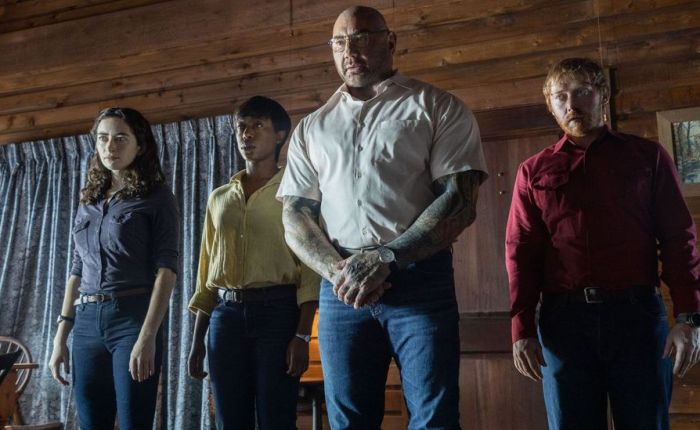
The movie starts with Wen, a young girl, catching grasshoppers outside a rustic cabin in some remote woods. A hulking stranger named Leonard (Dave Bautista of Guardians of the Galaxy) approaches Wen, and, though she knows not to talk to strangers, her trust is quickly earned by Leonard’s kind and gentle manner. But things turn ominous when she sees three others who Leonard says are with him approaching with odd-looking weapons. She runs to get the help of her dads, Daddy Eric (Frozen’s Jonathan Groff) and Daddy Andrew (Ben Aldrich), but it’s too late. Leonard and his three associates (including Harry Potter’s Rupert Grint) break into the cabin and deliver a startling ultimatum: they are messengers of the impending end of the world, a judgment that can only be spared if Andrew and Eric make the decision to sacrifice one of the members of their family. It turns out that each of the harbingers of doom were strangers to each other prior to undeniable visions they had of the coming destruction. When they find each other online and confirm that their visions were the same, they become convinced of the truth of the apocalyptic revelation and now must convince Andrew and Eric that only they can stop it. Of course, Andrew and Eric cannot believe such a ridiculous story, instead believing the readily apparent conclusion–formed from a lifetime of experience–that they are the victims of a hate crime. The movie becomes a dark hostage situation where Leonard and his compatriots grudgingly (for they are simply “normal” people like a teacher and a nurse who have no choice in the matter) go to the most extreme measures to convince Andrew and Eric of the truth of the situation while ushering in the judgment of the world. And, as some evidence that they might not be suffering from murderous bigotry or mass delusion comes through the TV that may or may not provide proof of this unbelievable story, Andrew and Eric are forced to not only confront their understanding of what is real, but then to decide how they will respond to it.
I found Knock at the Cabin to be Shyamalan’s best film since Signs. The story, adapted from the novel The Cabin at the End of the World by Paul Tremblay, is right in Shyamalan’s wheelhouse–the supernatural and material colliding in a way that makes characters adjust their understanding of the world. Shyamalan is helped a lot here by Dave Bautista’s star-making performance. He does a fine job of controlling his physicality when necessary, allowing Leonard’s apparent concern and heartbreak at what he feels compelled to do to because of his concern and heartbreak for the entire rest of the world. Nikki Amuka-Bird and Abby Quinn, as the other invaders/prophets, also get moments to let us see their characters as motivated by compassion even as they believe they have to do what the world would regard as evil. Aldrich is our stand-in, effectively responding in righteous anger and palpable disbelief at the crimes being perpetrated against them. Groff gets the thankless quieter role, making Eric a bit calmer and a bit more susceptible to the influence of the outsiders. The editing and close-up heavy camerawork add to the tension, even if the overbearing score and some really disappointing special effects shows try to let some of it get away.
But the real tension comes from the two choices that are put on Andrew and Eric. First, they have to decide whether they can believe the insanity in the story told to them. But even if they could get over that seemingly insurmountable hurdle, they still are given the choice to preserve their family–at least for a little while–while the rest of the world suffers. For every piece of evidence that gives them reason to trust what they know to be true about the world, another comes along to sow just a little more doubt. Shyamalan does not let the characters get an easy escape here; they must weigh what they know with what they are experiencing and wrestle with the consequences one way or the other. How they resolve that choice is a narratively and emotionally satisfying decision to affirm what is ultimately true and good. And that is belief at its best.
(Photo credit: Universal Pictures)
 Living at the Gates