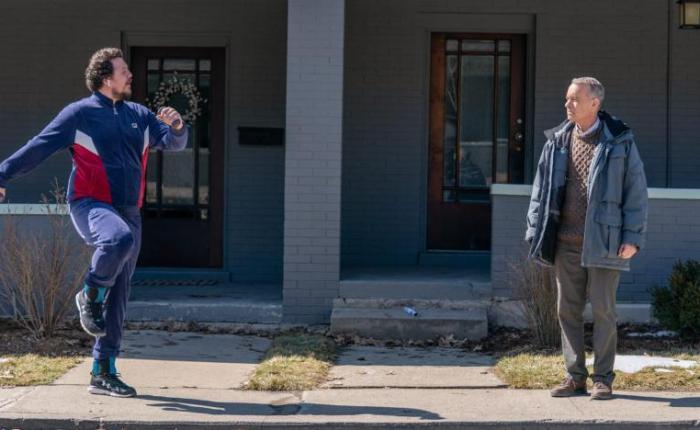
Otto is a pretty typical “grumpy old man.” Every day, he walks the block of his “gated” community (it’s a single street with a gate) and takes note of everything that his neighbors have done which violates the homeowner’s association. He does help his neighbors, but only because they are “idiots” who don’t know how to do the simple things he knows how to do and only after complaining about being called on to do it. As we dig deeper, Otto is not only grumpy, but truly angry; life has taken away the only thing he cares about and he has no desire to keep living. When a pregnant immigrant woman and her family move in across the street, however, Otto has to learn to come to terms with the anger that drives everyone away and see if he can embrace life with others, even if its not on his terms.
A Man Called Otto is an extremely faithful remake of 2015’s A Man Called Ove, a Swedish film based on a beloved best seller. To Americanize it, Tom Hanks takes on the role of Otto (because we don’t know many Oves in the US). While grumpier than most of his roles, this is the kind of performance that Hanks could do in his sleep, and he tackles it more than competently. Whether its arguing with a hardware store clerk because he has to pay for six feet of rope to get the five he wants, fighting with a renter about her dog peeing on his lawn, or shaming a local kid trying to earn a buck for throwing advertising circulars on the lawn, Hanks nails Otto’s disdain for a world that doesn’t seem to care about doing things the right way. We quickly learn that his disdain is tied up in pain; he is a recent widower, and the rope he has bought is meant to hang him and put him out of his misery. But his efforts at suicide misfire (including one attempt literally) as he keeps being interrupted by those around him, including new neighbor Marisol (beautifully played by new-to-me Mexican actress Mariana Treviño). Eventually, the two strike up an unlikely friendship, which looks like it might break through Otto’s defenses but becomes strained as he still tries to keep her at arm’s length.
There is a bad guy here: a real estate developmer is trying to take over Otto’s street one unit at a time. But the real antagonists are Otto’s self-sufficiency and his deep grief. While he is always annoyed at the people around him for their need of his help, he also never shies away from actually providing the help–everything from backing in a trailer to bleeding a radiator to giving driving lessons. But the idea that Otto would actually need help himself is horrifying to him. He has spent a lifetime taking care of everything around him and fighting the system that he recoils at idea of actually needing anyone else, especially now that he is “on his own.” But the point is that he’s not on his own. There are those around that truly need him for more than the tasks that he can do for them and who he truly needs to provide him a place among the living. The various characters in his neighborhood aren’t exactly family, but they are a real community–one in which people truly care for each other and give everyone a place not only to belong, but to serve each other and care for each other. That Otto has fought for years for the sake of the physical “community” of the street he lives on and missed the true need for the emotional community that other people can give provides A Man Called Otto with not only its story, but its purpose–to show us that we all need each other.
A Man Called Otto is a quintessential heartwarming tale. Some may consider it way too sappy or even emotionally manipulative. It might very well be, but there’s a sense in which that’s okay. When the story is worth telling, the emotional impact isn’t manufactured, but flows from that story. And A Man Called Otto‘s call for community is a story worth telling.
(Photo credit: Columbia Pictures)
 Living at the Gates