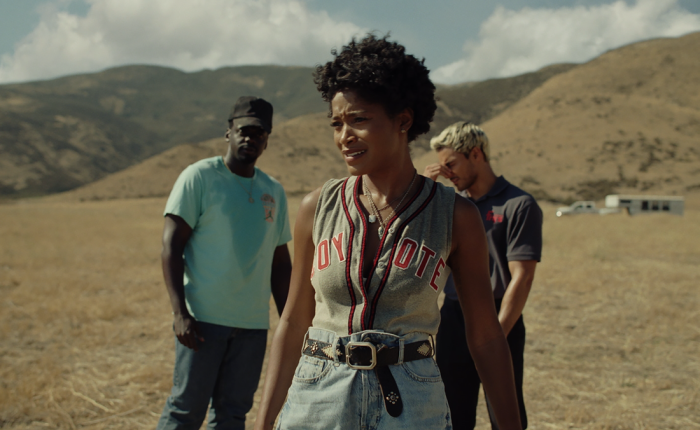
Jordan Peele is the new master of horror as cultural commentary. 2017’s Get Out is so highly regarded that it made the Sight and Sound Top 100 Best Films of All Time list this year. So, when Nope came out this summer, so did the think pieces of what big message Peele was trying to make. And he made a lot of them. Combining sci-fi and horror with a throwback to old UFO movies, Peele’s third film is a critique of such things as Hollywood and its treatment of minorities, the quest for fame and the predatory nature it unleashes, and man’s attempt to tame the natural world for his own ends. But, in addition to its many messages, Nope also works as one fantastically entertaining summer popcorn flick.
Daniel Kaluuya returns to the Peele-iverse as O.J. (talk about the uncomfortable intersection of Hollywood, race, and fame), the heir of a struggling Hollywood horse ranch that traces its roots back to the very first man–a jockey–ever seen in a moving picture. He, along with his less-interested sister Emerald (Kiki Palmer), try to keep the ranch afloat even as the opportunities dwindle following their father’s strange death. Times are so hard that O.J. has to sell horses to Jupe (Steven Yeun), a former child star who runs a roadside western-themed amusement park based on a movie he starred in, Kid Sheriff. Jupe has his own tragic backstory: a harrowing experience with a murderous chimpanzee on the set of a TV show featuring the two, the memorabilia from which he exploits in a strange museum open to those with an interest in the macabre.
Soon, we realize that there are strange things happening at the ranch with O.J.’s horses. Eventually, O.J. and Emerald figure out that there is a UFO–or, as O.J. and Emerald learn from a “Geek Squad” type guy from big-box electronics store, a “UAP”–that seems to be hunting on the property. It being 2022 in America, Emerald convinces O.J. that this is the opportunity to capture the object on film (the “Oprah shot”) to save the ranch and become famous. Later, we find that Jupe has also taken notice of the phenomenon and, as he has with everything else, tries to monetize it as an attraction. As we reach the third act, O.J. comes up with a plan to break (like a horse) the UFO in an extended sequence featuring a great TMZ bit, a hardcore cinematographer overly devoted to “the shot,” and the best use of giant windsock puppets ever.
The commentary is fascinating, even as it is less obvious than in Peele’s earlier work. Hollywood devalues and commodifies that which it can control. Minorities, be it the labors of O.J. and his ancestors, or Jupe and his Asian heritage for lots of “cute Asian kid” tropes, are one of those things. But so is nature, represented here by the animal world. Gordy (the murderous chimp) and the horses are the obvious examples at first, but, as we learn more about the UFO, we learn that it is also simply a being attempting to live its life. And the efforts to exploit it, as with Gordy, have terrifying results. Is Nope telling us not to exploit that which is subject to the domineering use of power over it? Or is it saying just to share the wealth when you do?
It’s hard to say that there are answers to questions like that, but you don’t need those answers to enjoy the heck out of Nope. Peele handles the much bigger scope of the film expertly. The horror is still horrific, the tension still tense, and the comedy still hilarious, but here, the action and massive set pieces just make everything more grand. Kaluuya and Palmer are great both in their own characterizations–O.J. the quiet working-man, Emerald the world-wise hustler–and are even better together. The effects work and technical aspects are as winning as the imagination that shaped them. Horror, comedy, commentary, big-budget spectacle–Nope works on all of those levels. And that makes it one of 2022’s best nights at the movies.
Nope is streaming on Peacock.
(Photo credit: Universal Pictures)
 Living at the Gates