What does it mean to be a family? What does it mean to be human? Can we all participate in a fun massive multiplayer online family dance-off? Technology presses into these questions in Kogonada’s second film, After Yang, a soft sci-fi story set in the not-too-distant future. In Kogonada’s vision, the answer to the third question is an exuberant “Yes!” The opening credits set to numerous families dancing against each other in the online world shows us that technological improvement can serve our families well. At the end of that sequence, however, those other two questions are thrust to the forefront. The film doesn’t try to force any answers on you, but simply shows you the fallout when the lines between technology and humanity blur.
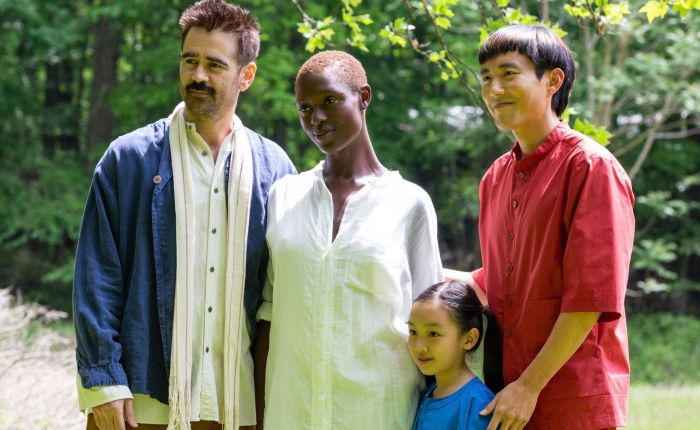
Colin Farrell (who had a brilliant year between this, The Batman, Thirteen Lives, and his possibly Oscar-winning turn in The Banshees of Inisherin) stars as Jake, the patriarch of a small family of him, his wife (Jodie Turner-Smith), their adopted Chinese daughter, and what appears to be her older brother, Yang (Justin H. Min). At the end of that all-too-fun dance-off, we find out that Yang is not human, but is a “techno-sapien,” a robot/android-type being who the family purchased from “Second Siblings” to help their daughter become familiar with her Chinese heritage. Yang malfunctions, and Jake has the duty to try to get him repaired. But, because they purchased him “refurbished” (“He was certified,” as Jake keeps reminding people), Jake has to delve into a world of black market techno-sapien repair. As he does, he finds that Yang had far more of a life than Jake, and those he encounters, thought possible. When Jake gains access to Yang’s “memories,” we see that Yang had the ability to appreciate beauty, engage in relationship, and–maybe–to feel, to dream, and to love. By the end, does Jake have a mere piece of hardware that has malfunctioned or a son that has experienced life as deeply as any human can?
So much of the movie depends on Farrell’s performance. This turns out to be a wise decision, because Farrell is essentially flawless. His emotions are never external, but always present. Jake’s daughter, a child, is allowed to clearly struggle with the emotions of losing her “big brother.” But Farrell must show Jake struggling with a loss that much of the world–especially his wife, who appears to retain a clinical coolness about Yang’s fate–cannot understand. You don’t get emotional about a TV that breaks, how is this different? But it is. The more he learns about Yang, the more he remembers Yang’s “humanity.” Although that isn’t necessarily the word for it. Jake meets Ada (Haley Lu Richardson in her second of two Kogonada films, a trend I hope continues), a young woman who befriended Yang and with whom he made many memories–although not necessarily romantic ones (“We never really talked about us in that way,” Ada tells Jake). When Jake asks her if Yang ever wished that he was human, Ada (who is also a child of technology in a different way) rejects the question, finding that the question is “such a human thing to ask” to assume that other beings would want to be human. Jake can’t really understand that point; what is life but to be human. For Farrell, that seems to humanize Yang even more.
Farrell gets the majority of the screen time, but the other actors get a lot of wonderful moments. In a flashback, Turner-Smith and Min share a thoughtful conversation about their understanding of the afterlife which shows that they, too, had a bond that is being severed. Richardson, as in Kogonada’s earlier film Columbus, is a wonder every time she is on the screen even, showing Ada struggling under the weight of trying to fit into a world that doesn’t want her. And Min imbues Yang with a beautiful mix of kindness and pathos, fully understanding and accepting Yang’s place in the world.
Kogonada’s video-essayist roots remain apparent even as his scope gets the slightest bit bigger. And that’s a good thing. While sci-fi is usually the stuff of big budgets and lots of CGI, he uses the subtlest touches of light and design to suggest a future that is still tethered to our reality. As in Columbus, nature plays a huge part in the feel of the movie, as hues of green and lots and lots of trees connect the technological with the natural. He uses his sense of space, color, and pace to ask questions far bigger than the intimate feel of the movie. Technology, family, memory, grief, and yes, humanity, are all in Kogonada’s scope. And the beauty and tenderness with which he treats all of those topics makes After Yang a truly special film.
 Living at the Gates